A diary you kept for four days
Someone is told to keep a food and symptom diary for the next appointment. They start with a notebook, write down breakfast and a vague “stomach OK”, and by Thursday the page is half empty. Lunch was eaten at a desk, dinner was somebody else’s recipe, and the evening cramps were noted at midnight as “bad night”.
When the gastroenterologist or dietitian opens the notebook, there are four days of partial notes where they wanted four weeks. It is not a lack of discipline. A diary that asks for effort at every meal and every symptom is a diary that loses.
An IBS food diary only works if it is faster than forgetting. That is the job Sayved is designed for.
Why does a photo and voice food diary beat memory?
Gut symptoms and meals sit on different clocks. The thing you ate at noon shows up as a feeling at three, or at nine, or the next morning. Reconstructing that from memory a week later produces a tidy story rather than a record.
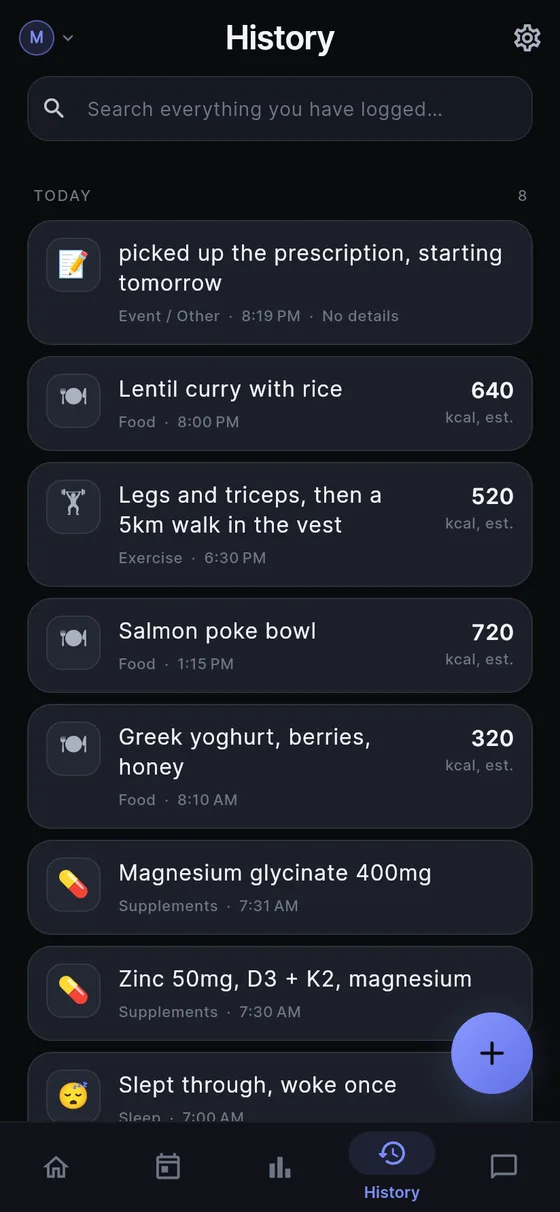
Capturing each side as it happens fixes the order. A photo of the plate takes a few seconds and keeps what was actually on it. A sentence about how your stomach feels takes five more. The two are stored as separate, dated entries, so “what did I eat before that?” is a question about real rows rather than hazy recall.
How do I set up an IBS food and symptom diary in two minutes?
- Create the condition. Settings → Conditions → New condition. Use your own word: “IBS”, “my gut”, “stomach issues”. The app stores it as written, and because you created it, the app never claims you have anything. If you want to keep it away from other people’s data, check the profile switcher first.
- Keep it in the right profile. Tracking for yourself, a partner and a child? Each person gets a separate profile under Settings → Family, with a name and nothing else asked.
- Choose what you log. Food and symptoms are the core. Add stimulants (coffee) and substances (alcohol) if relevant, and sleep or mood if stress is something you and your clinician discuss. Sayved sorts these automatically, so you never choose a category.
- Routines for the repeats. A daily fibre supplement or a regular breakfast is easy to save: open the entry, tap “Add to daily routine”, and from then on one tap files it. Symptoms are the exception and cannot be routines.
- A gentle prompt, if you want one. Settings → Reminders can nudge you at meal times with your own words. It is off by default and stays silent if you have already logged.
Entries that mention the condition by name are linked to it. Past entries are gathered up when you create it.
What do I say to log meals and gut symptoms?
Natural sentences are enough. Some real-sounding examples:
- “Two slices of toast with peanut butter and a flat white.”
- “Chicken curry from the takeaway, a large portion, and a beer.”
- “Cramps about a 6 on the left side, started after lunch.”
- “Urgent toilet visit twice this morning, otherwise fine.”
- “Skipped breakfast, felt hungry and a bit nauseous until eleven.”
One sentence can create several entries at once: the meal, the drink, the symptom. For ratings, the app uses one 0–10 scale where the number is how much of the named thing there is. Pain 10 is the worst pain. If you say “mild”, the app turns the word into a number, tells you it did, and lets you change it.
What should I ask my food and symptom diary after a month?
The Ask tab answers questions about your own log in plain language. It answers when you ask, never on its own, and it never says that one food causes a symptom. After a few weeks, questions such as these are useful:
- “How many days this month did I log bloating?”
- “What did I eat on the days I logged cramps of 5 or more?”
- “When did I last have dairy, and what did I log after it?”
- “How often did I log coffee on mornings with an urgent toilet visit?”
- “Show everything I logged under IBS in the last two weeks.”
These return rows from your log, laid side by side. Whether any link between them is real is a conversation for a clinician. With few entries, two things landing on the same day can easily be coincidence, and the answer carries a caveat when evidence is thin. Please do not cut out a food group because of a coincidence in a short log; discuss changes with a doctor or dietitian first. Our page on the food intolerance diary covers a related setup.
How do I take my IBS diary to the doctor?
Go to Settings → Doctor report. Pick the person, a period (one month, three months, six months, a year, or everything) and the IBS condition from the list. Keep “Include health, medication and mood” switched on if your clinician needs symptoms and medication in the same document.
You get a readable, day-by-day report that shows meals and symptoms in order, rather than a spreadsheet. It can be printed, saved as a PDF or emailed. Estimates keep their ranges and nothing in it is summarised or graded. For a more general checklist of what to bring, read about what to tell your doctor.
Honest limits
Sayved is a personal record, not a medical device. It does not tell you what is behind your symptoms, rule anything in or out, or suggest a diet. Blood in stool, unexplained weight changes, severe pain or anything that worries you are reasons to contact a doctor now, not to log and wait.
Reading voice and photos, and Ask, are part of Sayved Pro: 14 days free, then $2.99 per month. Everything you have already logged stays readable, searchable and exportable afterwards at no cost. See the food diary and symptom diary pages for more on how each type is stored.
 Sayved