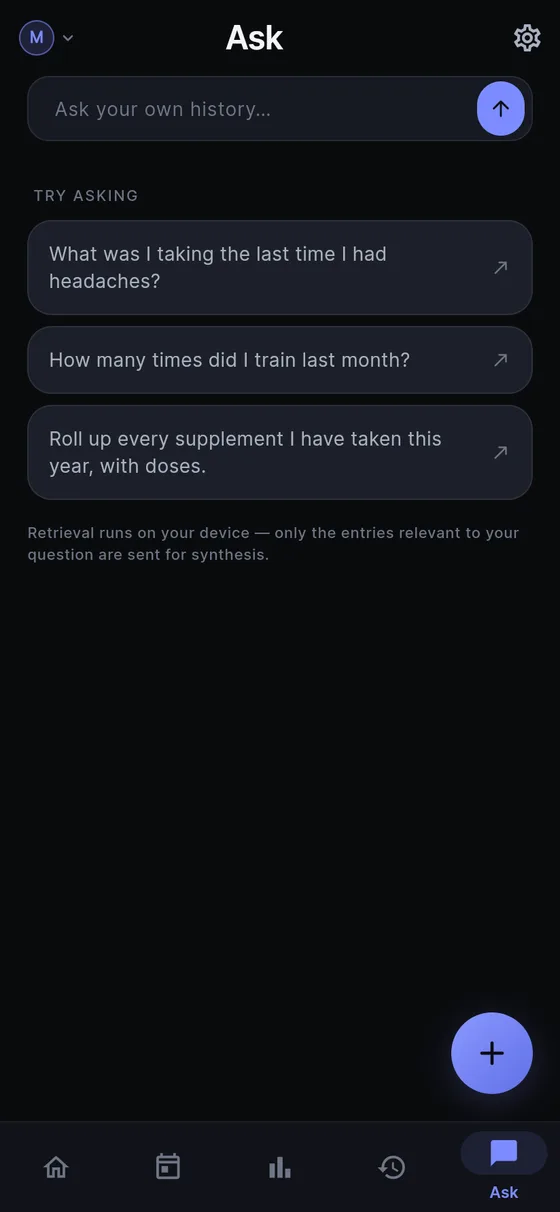
A diary is only worth keeping if you can get things back out of it. Ask is the tab that does that. You write a question the way you would say it out loud, and Sayved answers from what you logged. It is the reason to capture things at the moment they happen: months later, you do not have to remember.
What does it mean to have an AI health diary you can ask?
Most logs make you scroll. You find the week you want, then read line by line. Ask replaces that with a sentence. Some questions people actually type:
- “What was she taking the last time this rash came back?”
- “When did I last have ibuprofen?”
- “How many nights this month did I sleep under six hours?”
- “What did I eat on the days I wrote down a migraine?”
- “What was my blood pressure on the 12th?”
- “Which supplements have I taken this month?”
Sayved gathers the recent entries on your phone that could answer it, hands them to an AI model with your question, and shows you the answer. It is the diary doing the remembering, and you doing the asking.
Can I search my health history in plain language?
Yes, and that is the difference from a keyword search. You do not need to remember whether you called it “tummy ache” or “stomach pain”, or that a medicine was logged as “Nurofen”. The AI model reads the entries it is given and answers in plain words, including entries made by voice in loose wording.
Time wording in your question sets how far back Sayved looks. Words like “today”, “yesterday”, “this week”, “this month” or “this year” widen or narrow the window, and with no time word it looks at roughly the last three months. That window is deliberately generous, because missing the entry that answers the question is worse than sending a few extra. The honest consequence is that Ask is best at recent history. For a question about something long ago, put the period in the question (“this year”) and check the answer against History.
Counts and totals work too, because the model reads your rows as data: how many days, how many doses, the highest value you logged. When you want a longer stretch laid out for reading rather than a single answer, the health charts and reports view is the better tool, and the doctor visit report produces a printable document.
What is sent to the AI model when I ask a question?
Only a window of your entries, never the whole history. Sayved does not upload your history. It picks a window of recent entries on your phone, capped at a limited number, and sends those rows plus your question. The call carries no name, email or account, is stateless, and nothing from it is stored on Sayved’s servers. Your diary remains on your device.
This matters most for the sensitive categories. Everything outside the window stays on the phone. The privacy page states exactly what is processed and by whom.
Will it find patterns and triggers for me?
No, and that is a design decision rather than a gap. An app that announces “your headaches follow poor sleep” is making a medical-sounding claim from a few entries, and it can be wrong in ways that worry people. Sayved does not volunteer correlations.
What it will do is answer when you ask. If you ask “what did I eat in the 24 hours before each headache?”, it will list what you logged before each one. Whether that means anything is for you, and ideally a clinician, to decide. That boundary is also why Ask is described as answering from your own entries, not as advice.
How do I know the answer is right?
Check it. Every answer comes from rows in your own diary, so you can open History and look at the entries behind it. If Ask says you last took a medicine on the 9th, the entry for the 9th is there to confirm.
Errors come from three places. An entry might have been misheard when you dictated it, so correct it in History. You might have forgotten to log something, in which case the diary cannot know. Or the model might read your rows wrongly, which is why Sayved presents answers as a description of your entries and not as a verdict. Corrections you make are stored separately from the model’s original reading, and both are passed along so the answer can use your corrected value.
For anything you will act on, verify with the entry. For a doctor’s visit, use the printed report as the source rather than a screenshot of one answer.
Can I ask about my child or my parent?
Yes. Sayved keeps a separate log, a separate file on your phone, for each person. When you are inside a profile, Ask draws only on that profile, so a question about your daughter’s antibiotics will never mix in your own entries, and the reverse is just as true. See family health tracker for how profiles work. A parent can ask “what was he given the last time he had a fever, and how long did it last?” and get an answer from that child’s log alone.
Getting access
Ask is part of Sayved Pro. You get 14 days free, then $2.99 a month, covering every profile on the device. If you stop, you keep reading, searching, charting and exporting what you logged, free, forever. More on the pricing page.
 Sayved